
🌱 Free Resource: Introducing the Open Practice Program Readiness & Needs Assessment Framework

A practical tool for OER programs, nonprofits, small businesses, and mission-driven teams
After publishing my recent post, Open Education Doesn’t Need More Clutter. It Needs Clearer Pathways, I kept thinking about one thing:
The problem I was describing is not only an OER problem.
It is a program design problem.
In that post, I looked at the Open Education Association’s National Needs Assessment Survey Results and related OER program evaluation resources to explore what OER, open education, and affordable learning programs need right now. The short version: programs do not simply need more resources, more enthusiasm, or more awareness. They need clearer pathways, stronger infrastructure, better evidence, and support structures people can actually enter and use.
But the more I worked with those ideas, the more I realized the same pattern shows up in many value-driven programs.
A nonprofit may have a beautiful mission but no clear pathway for participants to engage.
A small business may have strong services but scattered onboarding, documentation, or client education.
An OER program may have great resources but no clear entry point for faculty.
A community initiative may have passionate people doing meaningful work, but too much of the process lives in one person’s head, inbox, or heroic over-functioning.
Different contexts. Same underlying issue. Good intentions are not the same thing as usable infrastructure.
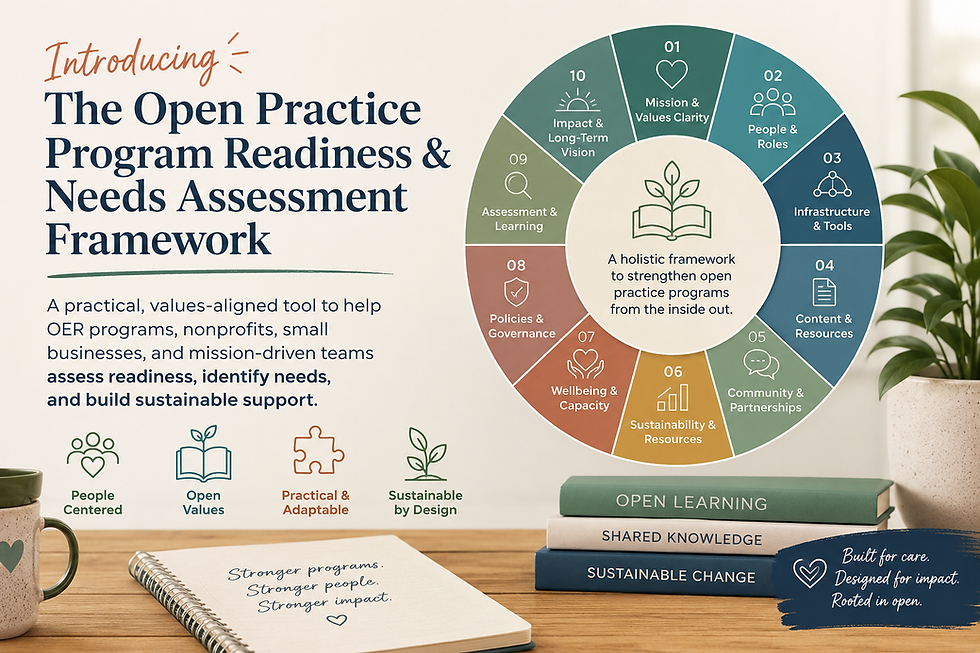
That is why I created the Open Practice Program Readiness & Needs Assessment Framework.
What the framework is
The Open Practice Program Readiness & Needs Assessment Framework is a practical tool for OER programs, nonprofits, small businesses, and mission-driven teams building learning, documentation, or support initiatives that need to be easier to enter, easier to manage, and easier to sustain.
It is designed to help teams step back and ask better questions before building another workshop, webpage, resource hub, training series, grant program, support process, or public-facing initiative.
Instead of starting with “What should we make?” the framework starts with:
Can people find the program?
Do they understand what it offers?
Do they know what to do first?
What support do they actually need?
Where does the work live?
What evidence helps us understand impact?
What labor is required to keep this going?
What would make the program more sustainable?
The goal is not to score perfectly across every category. The goal is to see the program clearly enough to make better decisions.
The 10 domains
The framework is organized around ten domains:
Entry & Navigation
Purpose & Change Goals
Participant & Stakeholder Support Needs
Resource Discovery & Curation
Implementation Pathways
Funding, Labor & Sustainability
Evidence & Evaluation
Equity, Ethics & Care
Documentation & Knowledge Transfer
Change Readiness
Together, these domains help programs examine both the visible parts of the work and the hidden structures underneath it.
The website, the intake form, the workshop, the guide, the resource list, the data spreadsheet, the shared folder, the grant process, the onboarding email, the meeting notes, the follow-up plan — these are not side details.
The Framework Table
Use the table below to guide review, planning, and evidence gathering across the ten readiness domains.
Domain | What this means | Guiding questions | Evidence to collect | What stronger readiness looks like |
1. Entry & Navigation | People need to be able to find the program, understand what it offers, and know what to do first. This includes websites, forms, onboarding, service menus, learning pathways, and first-touch communication. | Can people find the program easily? Is the invitation clear? Do people know where to start? Are next steps visible? Is the language understandable to someone outside the team? | Website/page review; intake form review; user journey map; inquiry emails; FAQs; search terms; consultation notes; feedback from first-time users. | People can find the door, understand the invitation, and take a first step without needing insider knowledge. |
2. Purpose & Change Goals | A program needs a clear reason for existing. This domain clarifies what the program is trying to change, for whom, and why. For OER programs, this may include affordability, access, faculty support, open pedagogy, or publishing. For nonprofits or small businesses, it may include learning, service delivery, client support, documentation, or community impact. | What problem or opportunity is the program responding to? Who is it meant to serve? What does meaningful progress look like? Are goals documented? Are stakeholders aligned around the purpose? | Mission statements; program descriptions; strategic plans; grant goals; stakeholder interviews; logic models; service descriptions; theory of change; past reports. | The program can clearly explain what it is trying to do, who it serves, why it matters, and how progress would be recognized. |
3. Participant & Stakeholder Support Needs | Programs work better when they are designed around real people, not imaginary ideal users. This domain identifies what participants, staff, faculty, clients, partners, or community members need in order to participate meaningfully. | What do people already understand? Where do they get stuck? What support formats do they prefer? What concerns or barriers do they have? Who is interested but not participating? Whose needs are least visible? | Needs assessment surveys; focus groups; interviews; consultation notes; workshop evaluations; help requests; participation patterns; stakeholder feedback; service inquiries. | Support is designed around real conditions, including workload, confidence, access, time, language, technology, and trust. |
4. Resource Discovery & Curation | Many programs have too many scattered resources and not enough usable pathways. This domain looks at how people find, evaluate, adapt, and trust the resources they need. In OER programs, this includes finding and evaluating open educational resources. In other settings, it may include guides, templates, training materials, documentation, client resources, or public-facing tools. | Where do people currently look for resources? Are resources organized around user needs? Can people tell which resources are current, relevant, and trustworthy? Are there curated pathways instead of giant link lists? Are resources easy to adapt or reuse? | Resource inventory; website analytics; content audit; repository review; OER tracker; landscape briefs; user feedback; documentation review; search logs; common resource requests. | People are not left alone with a pile of links. They have curated, contextualized resources that help them make decisions and take action. |
5. Implementation Pathways | Interest is not implementation. Programs need structures that help people move from curiosity to action, and from action to sustained practice. | What happens after someone expresses interest? Is there a clear pathway from learning to doing? Are there different levels of engagement? Are people supported before, during, and after implementation? Are follow-up structures in place? | Program workflows; onboarding sequences; grant pathways; badge/certificate structures; workshop series; planning templates; implementation plans; progress trackers; follow-up emails. | The program has clear bridges between interest, learning, planning, action, reflection, and continued participation. |
6. Funding, Labor & Sustainability | Values-driven work still requires time, money, staffing, tools, recognition, and maintenance. This domain makes labor visible so the program does not depend on burnout or heroic over-functioning. | What funding supports the program? Who does the labor? Is that labor recognized or compensated? What work is invisible? What would be needed to sustain or scale responsibly? What happens if a key person leaves? | Budget records; staffing maps; workload estimates; grant history; incentive records; maintenance task lists; role descriptions; sustainability plans; time-to-completion estimates. | The program can name the labor required, support it responsibly, and plan beyond one person's memory, energy, or unpaid extra work. |
7. Evidence & Evaluation | Programs need evidence that helps them understand reach, impact, barriers, learning, and change. Strong evaluation connects evidence to purpose instead of collecting random data at the end. | What data is currently collected? Does the evidence align with the program's goals? Are both numbers and stories included? What claims can be responsibly made? What do we still need to learn? | Participation data; outcomes data; cost savings; adoption records; student/client/community feedback; case studies; interviews; reflections; annual reports; dashboards; evaluation questions. | The program can tell a credible story using both quantitative and qualitative evidence, without overclaiming or flattening complexity. |
8. Equity, Ethics & Care | Equity and care should show up in the design, not just the values statement. This domain looks at privacy, accessibility, consent, inclusion, workload, communication, and human capacity. | Who benefits from the program? Who may still be left out? Are materials accessible? Are expectations humane? Is data collected ethically? Are stories shared with consent? Does the program reduce barriers or create new ones? | Accessibility reviews; consent language; privacy practices; participation patterns when appropriate; communication samples; workload feedback; user experience feedback; equity-focused reflections. | Care is built into the structure through clear expectations, accessible materials, ethical practices, humane timelines, and attention to who can actually participate. |
9. Documentation & Knowledge Transfer | If the work only lives in one person's head, inbox, or unofficial folder system, the program is fragile. Documentation helps the work become reusable, explainable, and sustainable. | Where does the work live? Can another person understand how the program operates? Are decisions documented? Are templates and workflows easy to find? What knowledge would be lost if someone left? | Shared folders; knowledge bases; SOPs; templates; decision logs; meeting notes; reports; calendars; program maps; landscape briefs; communication archives. | The program has institutional memory. People can understand, maintain, adapt, and continue the work without starting from scratch. |
10. Change Readiness | Programs operate in changing conditions. AI, policy shifts, funding changes, technology updates, political pressure, leadership turnover, and community needs can all affect the work. This domain asks whether the program can notice and respond to change with clarity. | What changes are affecting the program right now? How are decisions updated? Who interprets new risks or opportunities? Is there a process for revising guidance, tools, and strategy? How does the program avoid scrambling every time conditions shift? | Environmental scans; policy updates; AI or technology guidance; funding trend notes; stakeholder concerns; risk assessments; updated training materials; decision memos; strategy notes. | The program has a way to notice change, interpret it, and respond with strategy instead of panic. |
They are the infrastructure people use to enter and stay with the work.
Why I made it broader than OER
This framework is rooted in my work with OER, open education, and affordable learning programs. That is still one of its strongest use cases.
For an OER program, the framework can help examine faculty support needs, OER discovery pathways, Creative Commons licensing knowledge, student affordability evidence, grant structures, adoption workflows, and program sustainability.
But the same framework can also support other mission-driven initiatives.
For a nonprofit, it might help evaluate a community learning program, public resource hub, volunteer training process, or documentation system.
For a small business, it might help clarify client onboarding, educational content, service pathways, internal workflows, or support materials.
For a mission-driven team, it might help turn scattered effort into a clearer, more sustainable program.
That connection is important to me because open practice is not only about open licenses or open textbooks. It is also about how people are invited into work, how knowledge is shared, how support is structured, and how programs become usable instead of just well-intended.
How to use it
The framework can be used as a self-assessment, planning guide, discovery tool, or facilitated conversation.
A simple way to begin:
Review each domain.
Identify what is already working.
Name what feels unclear, fragile, or scattered.
Gather evidence from real users, participants, staff, faculty, clients, or stakeholders.
Choose two or three priority areas.
Build support structures around what people actually need.
You do not need to fix everything at once.
In fact, please do not try to fix everything at once. That is how frameworks become decorative PDFs in a folder named “Strategic Things” and everyone quietly moves on with their lives.
Start with the places where people are getting stuck.
Start where the work feels too dependent on one person.
Start where the invitation is unclear.
Start where the mission is strong, but the pathway is fuzzy.
From values to usable practice
A lot of mission-driven work begins with care, urgency, and belief. That matters. But values alone do not make a program usable.
People need pathways.
They need documentation.
They need clear invitations.
They need support that respects their actual capacity.
They need evidence that helps the program learn and improve.
They need structures that allow the work to hold without burning out the people carrying it.
That is the heart of this framework.
The Open Practice Program Readiness & Needs Assessment Framework is my attempt to name those structures and make them easier to examine.
👉 You can read the original research-based blog post here: Open Education Doesn’t Need More Clutter. It Needs Clearer Pathways.
👉 And you can access the framework here: Open Practice Program Readiness & Needs Assessment Framework
Because good work deserves more than good intentions.
It deserves a pathway people can actually use.
AI Use Disclosure
This post was developed with AI-supported assistance for brainstorming, organization, drafting, revision, editing, and/or source-note synthesis. I use AI as a thinking and accessibility tool, not as a replacement for human judgment, lived experience, professional expertise, or ethical responsibility.
The ideas, interpretation, framing, source selection, final language, and editorial decisions are my own. When this post includes research, reports, or external sources, I review source material directly and connect claims to cited references rather than treating AI-generated text as evidence.
Nothing in this post was published AI verbatim, unchecked, or uniterated. I reviewed, revised, reshaped, and approved the final version before publication.
For more about how The Open Practice Academy uses AI, see my site-wide AI Use Acknowledgment.


Comments